
It’s Monday morning. Your inbox is overflowing, the content calendar is half empty, two reports are due by noon, and a client wants “just a few quick tweaks” to last week’s campaign. Sound familiar?
Marketing teams are expected to do more, across more channels, with the same headcount. That pressure is why so many leaders are exploring AI in marketing, and why so many teams quietly worry about what it means for their jobs.
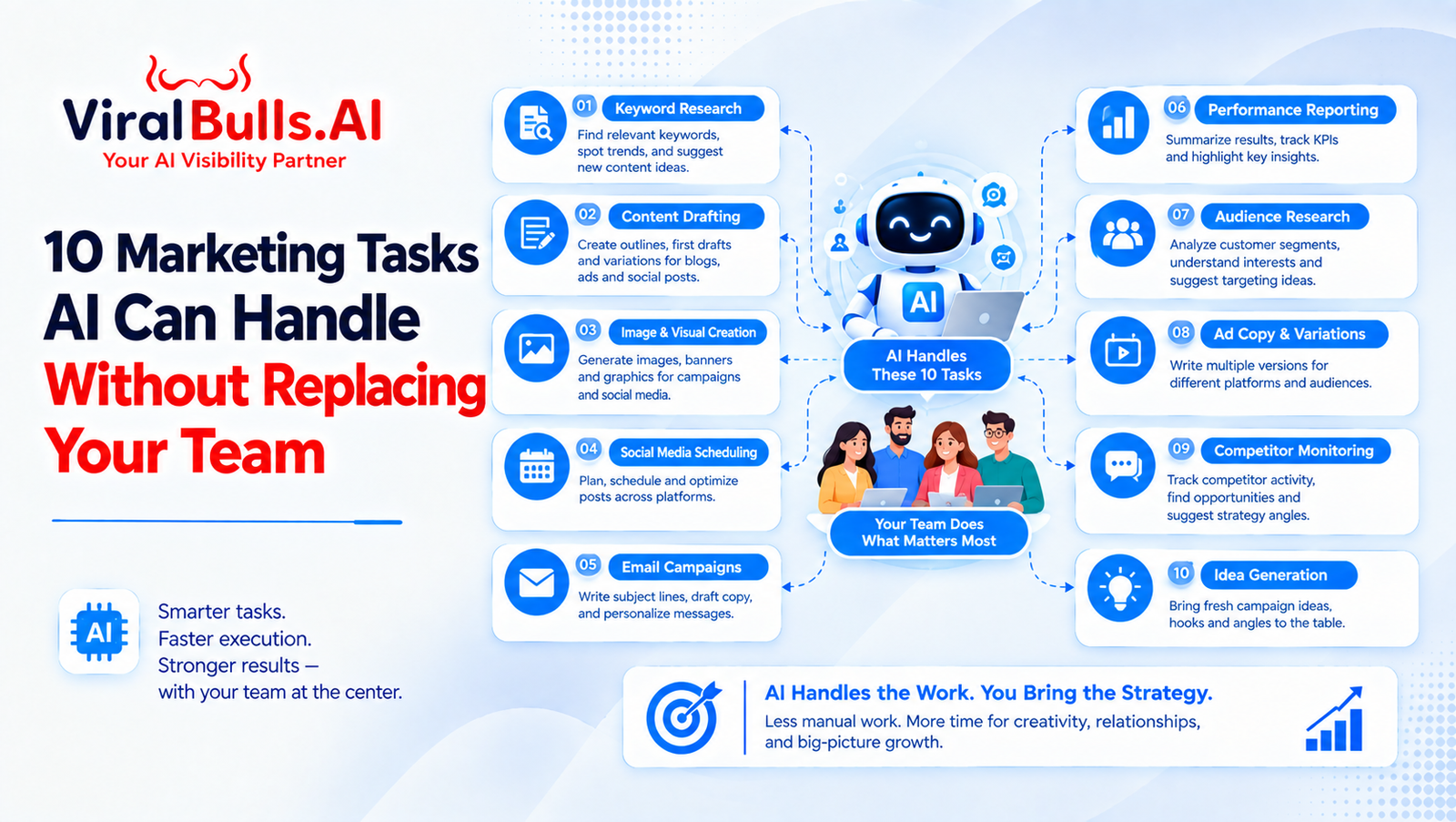
Here’s the good news: AI isn’t here to replace your marketers. It’s here to take repetitive, time-draining work off their plates so they can focus on strategy, creativity, and relationships. Below are 10 marketing tasks AI can handle today, and exactly where your team still leads.
Why AI Works Best as a Teammate, Not a Replacement
AI excels at speed, volume, and pattern recognition. It struggles with brand instinct, cultural nuance, empathy, and knowing when to break the rules. Great marketing needs both.
The winning formula is simple: AI drafts, analyzes, and automates; humans decide, refine, and connect. Keep that in mind as you read through the list. Businesses that adopt this mindset typically publish more, respond faster, and still sound unmistakably like themselves.
10 Marketing Tasks AI Can Handle for You
1. Keyword Research and SEO Analysis
Manual keyword research can eat hours. AI marketing tools can cluster keywords by search intent, uncover content gaps, and analyze competitor pages in minutes, giving your SEO strategy a faster, smarter starting point and freeing your strategist to plan instead of dig through spreadsheets.
Your team’s role: Choose which topics truly fit your brand, audience, and business goals.
2. First-Draft Content Creation
Blank pages slow everyone down. AI can generate blog outlines, social captions, email drafts, and product descriptions in seconds, so writers begin with something to shape instead of nothing to stare at. The result is faster turnaround without sacrificing quality.
Your team’s role: Add your voice, verify facts, and weave in the stories only your brand can tell.
3. Social Media Scheduling and Repurposing
One blog post can become a carousel, a reel script, and a LinkedIn post. AI handles that repurposing, suggests the best posting times, and keeps your calendar full without constant manual effort. Consistency is one of the biggest drivers of social growth, and automation makes it achievable.
Your team’s role: Engage with comments, join conversations, and build real community.
4. Email Personalization and A/B Testing
AI can segment lists, write subject line variations, predict optimal send times, and run split tests automatically. Small improvements in open and click rates add up quickly across every campaign, especially for larger lists.
Your team’s role: Craft the offer, the relationship, and the message strategy behind the send.
5. Reporting and Performance Analytics
Pulling numbers from five platforms into one report is nobody’s favorite job. AI can build dashboards, summarize trends in plain language, and flag unusual spikes or drops the moment they happen.
Your team’s role: Explain the “why” behind the data and turn insights into decisions clients can act on. Numbers alone never tell the full story.
6. Ad Copy and Creative Testing
Paid campaigns thrive on testing. AI can produce dozens of headline and description variations, then shift budget toward top performers as results roll in, reducing wasted ad spend and giving your media buyer more time for planning.
Your team’s role: Develop the big creative concept that makes people stop scrolling.
7. Audience Research and Social Listening
AI can scan reviews, comments, and forums to reveal trending topics, sentiment shifts, and recurring customer questions, surfacing insights that would take a person weeks to gather by hand. Better audience understanding leads to sharper messaging.
Your team’s role: Interpret what those signals mean emotionally and respond with empathy.
8. Customer Support and Lead Qualification
Chatbots can answer common questions around the clock, while AI lead scoring highlights which prospects are ready for a conversation. Customers get instant answers, and your sales team spends time only on qualified leads.
Your team’s role: Handle complex, sensitive, or high-value conversations and close the deal.
9. Content Optimization and Updates
Old posts lose traffic quietly. AI can audit existing content, suggest fresh meta titles, improve internal linking, generate image alt text, and recommend updates that help you appear in both traditional search and AI-generated answers (often called GEO, or generative engine optimization).
Your team’s role: Approve changes and keep everything accurate and on-brand.
10. Workflow and Admin Automation
Meeting notes, creative briefs, task assignments, approval reminders, and invoice follow-ups are necessary but draining. AI automation handles these small tasks so projects keep moving without constant nudging. Small time savings here add up to hours every week.
Your team’s role: Lead the team, set priorities, and protect time for deep, creative work.
What AI Still Can’t Do
Even the best tools have blind spots. AI can’t truly understand your client’s story, read the mood of a room, or sense when a joke might land badly. It can also produce confident-sounding mistakes, which is why human review is non-negotiable.
Trust, humor, ethics, and originality remain human strengths, and they are exactly what make audiences choose one brand over another. Treat AI as a fast, tireless assistant, never as the final decision-maker.
How to Start Using AI in Your Marketing Team
You don’t need to overhaul everything at once. A gradual approach builds confidence and protects quality:
- Start with one pain point. Pick the task your team dislikes most, such as reporting or first drafts, and test AI there.
- Set clear guardrails. Define brand voice rules, fact-checking steps, and a human approval stage for everything public.
- Train your people. Teach your team to write strong prompts and review AI output critically.
- Measure and expand. Track time saved and results, then add the next task.
The Bottom Line
AI marketing tools are powerful, but they are only as effective as the people guiding them. Handing off repetitive tasks doesn’t shrink your team’s value; it multiplies it. Your marketers get time back for the work that grows brands: strategy, storytelling, and genuine human connection. In a crowded digital landscape, that combination of machine efficiency and human creativity is what helps brands stand out, earn trust, and grow steadily.
Ready to build an AI-powered workflow that supports your team instead of sidelining it? Connect with Viralbulls AI and let’s put these tasks to work for you.
Frequently Asked Questions
Will AI replace my marketing team?
No. AI automates repetitive tasks, but strategy, creativity, brand judgment, and relationship-building still need people. Teams that use AI well usually get more done, not smaller.
What is the easiest marketing task to automate first?
Reporting and first-draft content are great starting points. They are time-consuming, low-risk, and easy to review before anything goes live.
Is AI-generated content good for SEO?
It can be, when a human edits it for accuracy, originality, and usefulness. Search engines reward helpful content, regardless of how the first draft was created.
Do I need technical skills to use AI marketing tools?
Not really. Most tools are built for non-technical users. Clear prompts and good editing judgment matter more than coding knowledge. A short training session is usually enough to get your team started.
How do I keep my brand voice consistent with AI?
Share a brand style guide, example content, and tone rules in your prompts, then review every output before publishing.