You already know personalization works. Customers who see messages that feel written just for them click more, buy more, and stay loyal longer. But there is a catch every marketer knows well: the moment you start splitting lists, rewriting emails for six audiences, and tweaking ad copy for every persona, your to-do list explodes.
For many teams, “personalized marketing” has quietly become code for “more late nights.”
Here is the good news. It does not have to be that way. When used well, AI marketing personalization takes over the repetitive, time-draining tasks so your team can focus on strategy and creativity. In this guide, you will learn what smart personalization looks like, where AI saves the most time, and how to start this week.
Why Personalization Matters More Than Ever
Today’s audiences are flooded with content. Generic messages get scrolled past, deleted, or ignored. People now expect brands to understand their interests, remember their behavior, and speak to their needs.
Personalization delivers on that expectation. It improves open rates, raises click-through rates, lowers ad waste, and builds the kind of trust that turns first-time buyers into repeat customers. For digital marketing agencies and in-house teams alike, it is one of the most reliable ways to improve results without simply spending more on ads.
The problem has never been the “why.” It has always been the “who has time?”
The Manual Work Trap
Traditional personalization is labor-intensive. Think about what it usually takes:
- Exporting customer data and sorting it into segments by hand
- Writing multiple versions of the same email, landing page, or ad
- Guessing the best send time for each group
- Building rules and workflows for every possible customer journey
- Reviewing reports to work out what actually worked
Every added segment multiplies the workload. Soon a team of three is trying to run a campaign that needs a team of ten. Quality slips, deadlines stretch, and personalization gets abandoned in favor of the same one-size-fits-all blast.
This is exactly where AI changes the equation.
How AI Personalizes Marketing at Scale
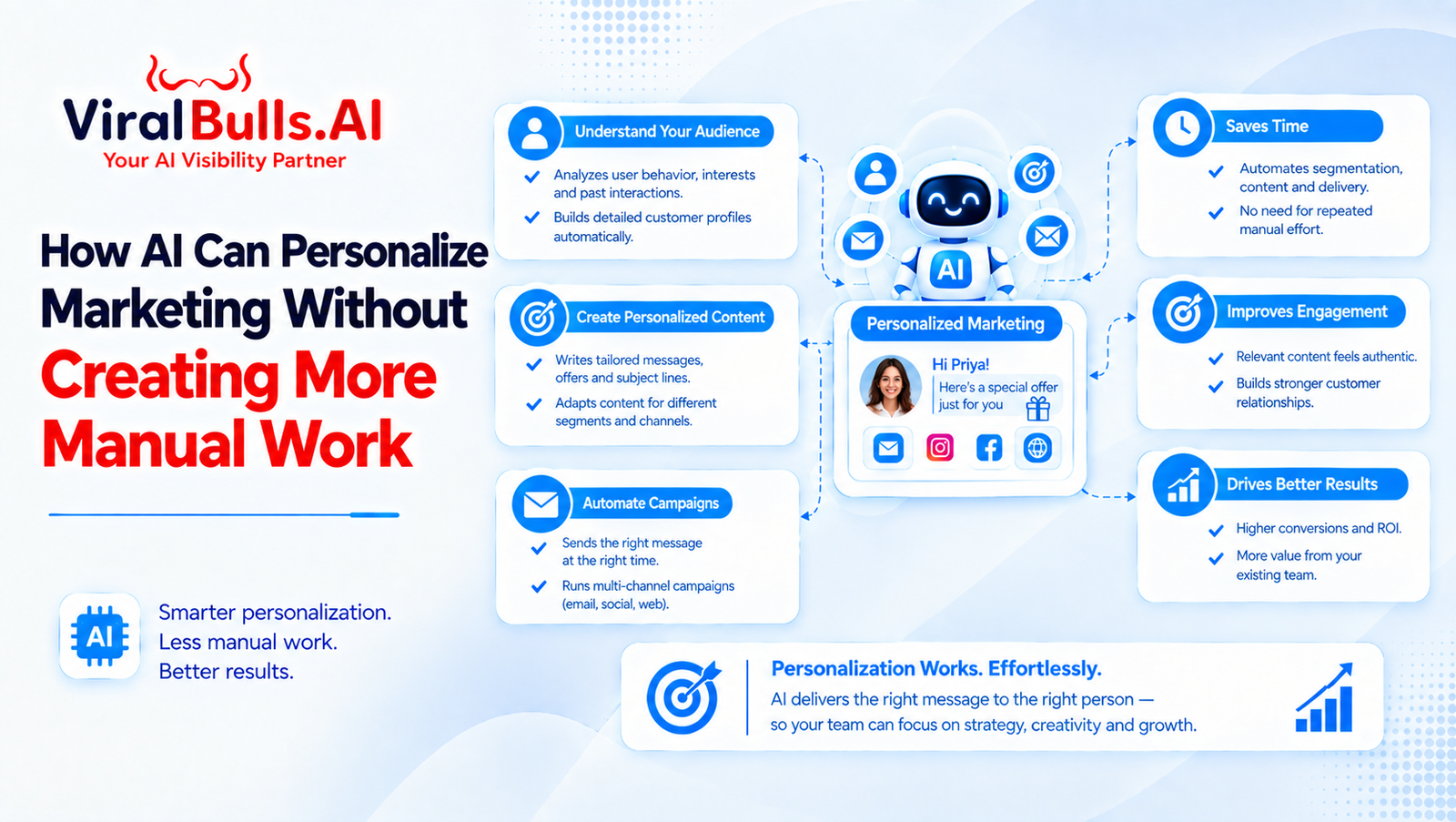
AI does not replace your marketing judgment. It automates the tedious parts of personalization so you can apply that judgment where it counts. Here are the areas where it saves the most effort.
1. Smarter Audience Segmentation
Instead of building segments by hand, AI tools analyze behavior such as pages visited, products viewed, purchase history, and engagement patterns. They group people automatically and update those groups as behavior changes. Your segments stay fresh without a weekly spreadsheet session.
2. Dynamic Content Creation
Generative AI can turn one core message into many tailored versions. Write your main email once, and AI can adapt the tone, offer, and call to action for new customers, loyal buyers, and lapsed subscribers. You review and refine rather than write from scratch, which can cut production time dramatically.
3. Predictive Recommendations
Recommendation engines learn what each person is likely to want next and surface it automatically, whether in an email, on your website, or inside an ad. This is how streaming platforms and online stores make every visitor feel like the store was built for them.
4. Send-Time and Channel Optimization
AI can learn when each subscriber is most likely to open an email and which channel they respond to best, whether that is email, WhatsApp, or social media. No more debating the perfect Tuesday morning slot.
5. Automated Testing and Reporting
Instead of running one A/B test at a time, AI can test many headline, image, and offer combinations at once and shift budget toward winners. It also summarizes performance in plain language, so you spend less time in dashboards and more time acting on insights.
What This Looks Like in Real Life
Imagine a salon brand with 5,000 subscribers. Manually, the team would send one monthly newsletter to everyone. With AI, the same team sets up a single workflow. A first-time visitor who browsed hair-color services receives a welcome offer for exactly that. A regular client gets a reminder timed to her usual booking cycle. A customer who has not visited in 90 days receives a friendly win-back message.
Once built, all three journeys run on their own. The team’s ongoing effort is a short monthly review, not a daily grind. That is the real promise of AI personalization: more relevance for the customer, less busywork for you.
A Simple 5-Step Plan to Get Started
You do not need a huge budget or a data science team. Follow this practical framework to add personalization gradually and keep the workload light.
- Start with one goal. Pick a single outcome, such as higher email click-through or more repeat purchases. Focus keeps your setup simple.
- Clean and connect your data. AI is only as good as the information it receives. Make sure your CRM, website analytics, and email platform share consistent customer data.
- Choose tools that integrate. Look for platforms that plug into what you already use. A tool that needs constant manual uploads defeats the purpose.
- Automate the first workflow. A welcome series, an abandoned-cart reminder, or a re-engagement email is an ideal starting point. Set it up once and let it run.
- Measure, learn, and expand. Review results monthly, keep what works, and only then add the next segment or channel.
The rule of thumb: if a new personalization tactic creates recurring manual tasks, adjust the setup before scaling it.
Common Mistakes to Avoid
- Over-personalizing. Messages that feel too specific can seem invasive. Personalize around interests and behavior, and respect privacy.
- Skipping human review. AI drafts are a strong starting point, but your team should always check tone, accuracy, and brand voice.
- Ignoring data privacy. Collect data transparently and follow applicable regulations, including India’s data protection rules.
- Chasing every tool. More software often means more manual work. Choose a small, connected stack instead.
The Future Is Personal, and Effortless
The brands that win are not the ones that work the hardest. They are the ones that work the smartest. AI makes it possible to deliver relevant, human-feeling experiences to every customer while your team keeps its time, energy, and creativity.
Start small, automate one workflow, and build from there. Personalization should feel like a growth engine, not a second job.
Ready to personalize your marketing without the extra workload? Connect with the ViralBulls AI team and discover how smart automation can help your brand grow faster.
Frequently Asked Questions
What is AI marketing personalization?
It is the use of artificial intelligence to tailor content, offers, and timing to each customer based on their behavior and preferences, automatically and at scale.
Will AI replace my marketing team?
No. AI handles repetitive tasks like segmentation, testing, and first drafts. Strategy, creativity, and brand judgment still need people.
Do small businesses need a big budget for AI personalization?
Not at all. Many email platforms, CRMs, and ad tools include AI features already. Begin with one workflow and expand as results come in.
How much customer data do I need to get started?
You can begin with basics such as purchase history, website behavior, and email engagement. Quality and consistency matter more than volume.
Is AI-generated content safe to use as it is?
Treat it as a strong first draft. Always review for accuracy, tone, and brand fit before publishing.
How do I keep personalization from feeling creepy?
Personalize based on interests and actions customers have willingly shared, be transparent about data use, and avoid overly specific references.
How soon can I see results?
Simple automated workflows, such as welcome or cart-recovery emails, often show improvement within a few weeks. Measure monthly and refine.