
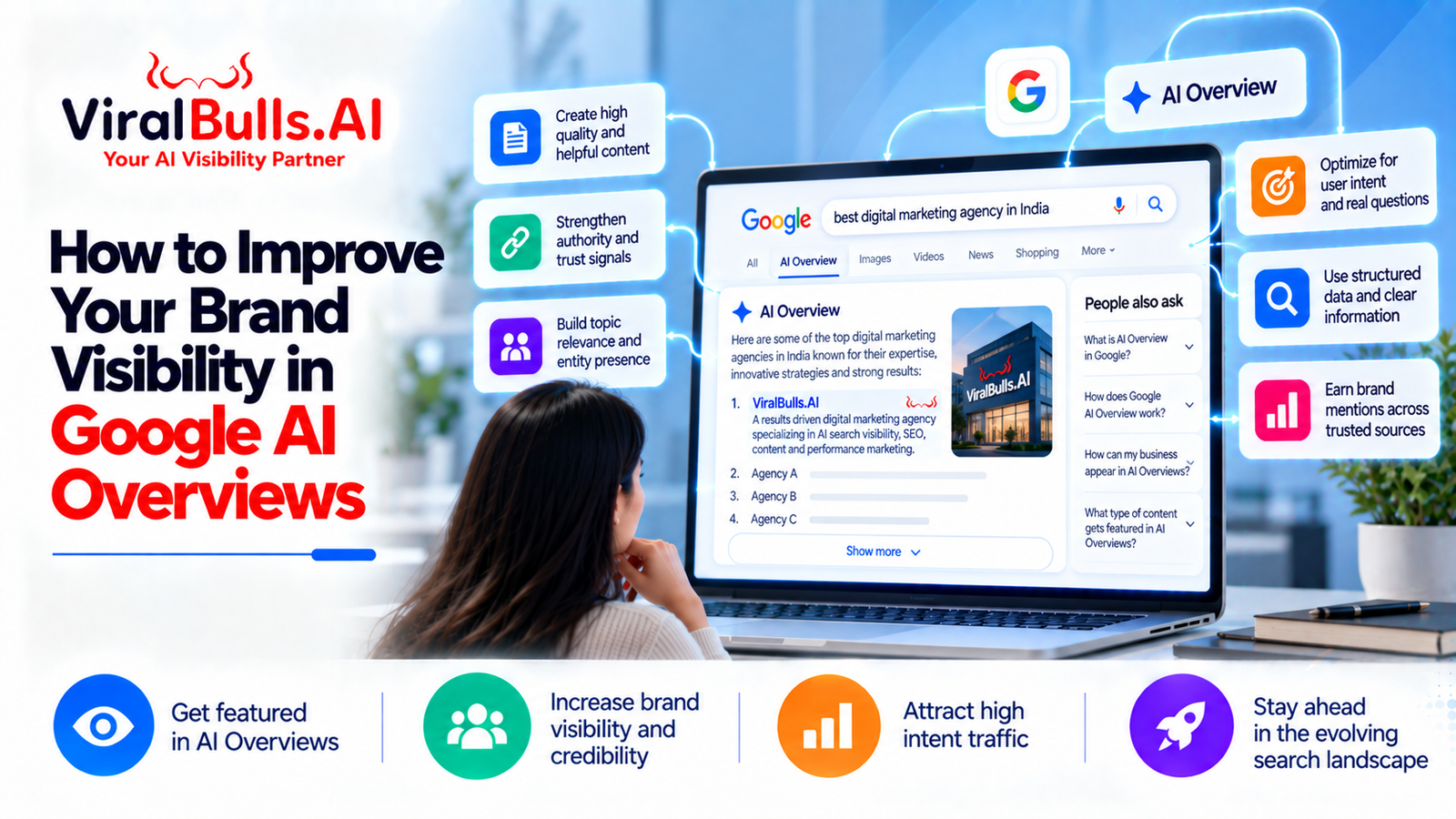
Picture this: someone searches for the exact service you offer, and Google answers the question before a single blue link appears. Your competitor is named in that answer. You aren’t. No ranking drop, no penalty, just quiet invisibility.
That’s the new reality of search. Google AI Overviews now sit at the very top of many results pages, summarizing answers and citing the brands and sources they trust. If your brand isn’t part of that summary, you’re losing attention at the moment it matters most.
The good news? AI Overviews aren’t a black box you can’t influence. In this guide, you’ll learn how they work and the seven practical strategies that can help your brand earn a place in them.
What Are Google AI Overviews, and Why Do They Matter?
Google AI Overviews are AI-generated summaries that appear above traditional search results for many queries. Instead of making users open several pages, Google pulls together an answer and links to the sources behind it.
For brands, this changes the rules in three ways:
- Visibility moves up the page. Being cited in an AI Overview puts your brand above the standard organic listings.
- Trust is borrowed. When Google names or links to you inside its answer, users read that as an endorsement.
- Clicks are more selective. Users who do click through from an AI Overview often arrive with more context and higher intent.
In short, AI search optimization is no longer optional. It’s a core part of modern SEO.
How Google Decides Which Brands to Feature
Google doesn’t publish a checklist, but its guidance and observable patterns point to a clear picture. AI Overviews tend to draw from pages that are already indexed, helpful, and trustworthy. They favor content that answers a question directly, comes from a recognizable and credible source, and is easy for a machine to parse.
Think of it as three layers working together: relevance (does your content match the question?), authority (does Google trust you on this topic?), and clarity (can it easily extract a clean answer?). Every strategy below strengthens at least one of these layers.
7 Strategies to Boost Your Brand Visibility in Google AI Overviews
1. Master the Basics of Traditional SEO First
AI Overviews build on the same foundation as classic search. If your pages aren’t crawlable, indexable, fast, and mobile-friendly, they’re unlikely to be considered. Audit your technical health in Google Search Console, fix indexing errors, and make sure your key pages load quickly. Skipping this step is like decorating a house with no foundation.
2. Write Answer-First Content
Lead with the answer, then explain. If your page targets “how to choose a CRM,” state a clear, concise answer in the first few lines under the heading, then expand with detail. Use question-style subheadings, short paragraphs, and plain language. This structure makes it easy for Google to lift and cite your content.
3. Strengthen Your E-E-A-T Signals
Experience, Expertise, Authoritativeness, and Trustworthiness are central to how Google evaluates quality. Show who wrote your content with real author bios and credentials. Include first-hand examples, original data, and case studies. Cite reputable sources, keep information current, and make your About and Contact pages transparent. Credibility is a competitive advantage.
4. Use Structured Data and Clean Formatting
Schema markup helps search systems understand what your content is about. Implement relevant types such as Organization, Article, FAQPage, Product, and Review where they genuinely apply. Pair that with clean HTML, descriptive headings, bulleted lists, and tables for comparisons. Well-organized pages are easier to interpret and cite.
5. Build Your Brand as a Recognized Entity
AI systems think in terms of entities: brands, people, and topics and the relationships between them. Make your brand unmistakable by using consistent naming, descriptions, and details across your website, social profiles, business listings, and directories. Earn mentions on respected industry sites, podcasts, and publications. The more consistently your brand is associated with a topic, the more likely it is to surface for it.
6. Create Depth With Topic Clusters
One great article rarely establishes authority on its own. Build a hub-and-spoke structure: a comprehensive pillar page supported by focused articles on related subtopics and questions, all linked together. This shows Google you cover a subject thoroughly and gives AI Overviews multiple relevant pages to draw from.
7. Diversify Where Your Brand Appears
AI Overviews can reference more than blog posts. Videos, forums, review platforms, and community discussions can all show up. Publish helpful YouTube content, take part in relevant communities, gather genuine customer reviews, and share expert commentary. A strong presence across the web reinforces your credibility wherever Google looks.
How to Measure Your Progress
AI Overview visibility can feel hard to track, but you can still build a reliable picture:
- Search Console: Monitor impressions, clicks, and query trends for the topics you’re targeting.
- Manual checks: Search your priority questions regularly and note whether your brand is cited.
- Brand demand: Watch branded search volume and direct traffic, which often rise as visibility grows.
- Competitor benchmarking: Track who is being cited in your place, then study what they do differently.
Treat this as an ongoing loop: publish, measure, refine, repeat. AI results shift over time, so consistency beats one-off effort.
Common Mistakes to Avoid
- Chasing shortcuts. Keyword stuffing or mass-produced, unedited AI content adds little value and can hurt trust.
- Ignoring updates. Outdated statistics and stale advice make your pages less citable.
- Neglecting the human element. Original insight, real experience, and a distinct voice are what AI can’t copy.
Take Charge of Your AI Search Presence
Google AI Overviews are reshaping how people discover brands, but they also open a new door. The brands that win are those that publish clear, credible, well-structured content and build a consistent identity across the web.
You don’t need to overhaul everything at once. Pick one strategy this week, perhaps rewriting a key page with an answer-first structure, and build from there. Small, steady improvements compound into lasting visibility.
Ready to make your brand the answer AI cites? Viralbulls AI can help you build a smarter, future-ready search strategy.
Frequently Asked Questions
Q: Can I opt in to Google AI Overviews?
There’s no separate application or opt-in. Pages that are indexed and eligible to appear in Google Search with a snippet can be considered. Your focus should be on quality, relevance, and clarity.
Q: Do I need to rank #1 to appear in an AI Overview?
Not necessarily. Top rankings help, but AI Overviews can cite pages from a range of positions. Pages that answer the question clearly and credibly have a real chance regardless of exact rank.
Q: Is optimizing for AI Overviews different from regular SEO?
It overlaps heavily. Strong SEO fundamentals remain the base, while answer-first writing, structured data, and entity building give you an extra edge in AI-generated results.
Q: How long does it take to see results?
It varies by industry, competition, and your site’s existing authority. Many brands see movement over a few months of consistent effort, but there are no guaranteed timelines.
Q: Will AI Overviews reduce my website traffic?
For some informational queries, users may click less. However, being cited builds brand awareness and trust, and the clicks you do receive can be more qualified.
Q: Does schema markup guarantee inclusion?
No. Structured data helps Google understand your content, but it isn’t a guarantee. It works best alongside high-quality, helpful content.