
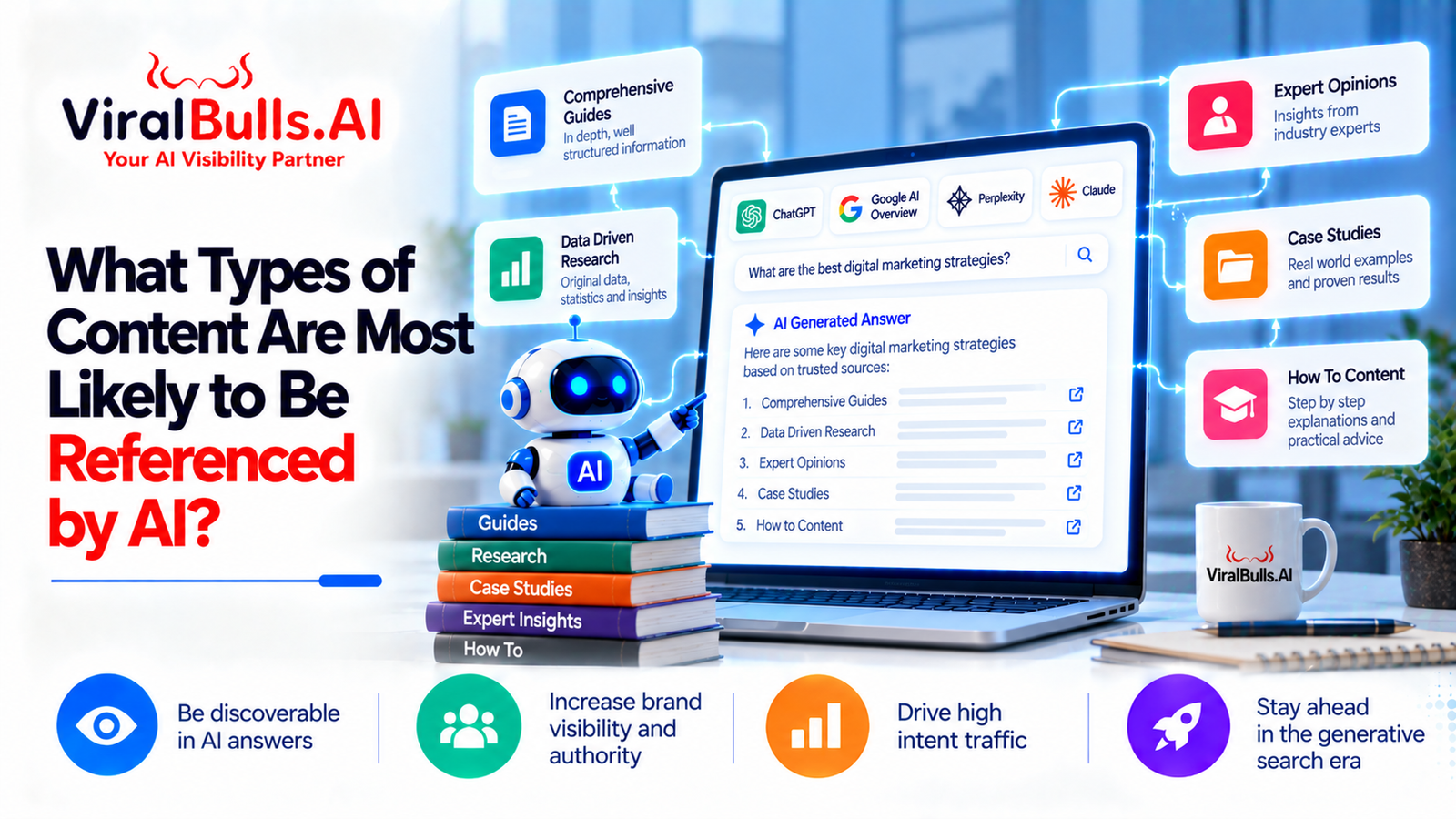
Picture this: a salon owner opens ChatGPT or Perplexity and asks, “Which digital marketing agency understands beauty businesses?” Within seconds she gets a confident answer with a few sources named. Either your brand is in that answer, or it simply does not exist for her. There is no page two.
That is the new reality of search. AI assistants now summarize, recommend, and cite before a user ever clicks a blue link. The good news? AI does not pick sources at random. Certain types of content get referenced again and again, and you can create them on purpose. In this guide, we break down exactly what those content types are, why they work, and how to start publishing them today.
Why Being Referenced by AI Matters
Traditional SEO was about ranking. Generative engine optimization (GEO) is about being the source an AI trusts enough to quote. When your content is cited in an AI-generated answer, you gain three things: visibility at the exact moment of decision, borrowed credibility from the platform, and high-intent traffic from people who already like what they read about you.
Businesses that adapt early are building an advantage that will be hard to catch. Those that wait will watch competitors become the “default answer” in their industry.
How AI Decides What to Reference
Before we get to the content types, it helps to understand the logic. Large language models and AI search tools look for content that is:
- Clear and easy to extract: direct answers that can be lifted without confusion.
- Credible: backed by data, named experts, and reputable sources (the principles of E-E-A-T: experience, expertise, authoritativeness, and trustworthiness).
- Well structured: logical headings, lists, tables, and schema markup.
- Fresh and consistent: updated regularly and echoed across trusted websites.
Keep these four filters in mind. Every content type below performs well because it satisfies most of them.
The 8 Content Types AI Is Most Likely to Reference
1. Original Research and Data
If there is one content type AI loves, it is a unique statistic. Surveys, benchmark studies, and performance analyses give AI something it cannot get anywhere else. When you publish original numbers, such as “we analyzed 50 salon Instagram accounts and found that Reels drove the highest reach,” you become the primary source, and primary sources get cited. Even small, well-documented studies from your own client data can work if you explain your method clearly.
2. Clear Definitions and Explainers
AI tools constantly answer “What is…?” questions. Content that opens with a crisp, one or two sentence definition, then expands with context, is perfect raw material. Think of it as writing the answer first and the explanation second. Explainers on topics like GEO, local SEO, or content calendars are ideal for this.
3. FAQ and Question-Based Content
Users talk to AI in full questions, and FAQ content mirrors that behavior. Pages that pair a real question with a direct, complete answer are easy for AI to match and quote. Add FAQ schema markup to make the structure even clearer to machines.
4. Step-by-Step How-To Guides
Procedural queries such as “how do I set up a Google Business Profile?” are extremely common. Numbered steps with clear outcomes are simple for AI to summarize, which makes how-to guides one of the most frequently referenced formats. Be specific: include tools, timeframes, and common mistakes.
5. Comparison and “Best Of” Content
When people ask AI to help them choose, it looks for balanced comparisons. Tables that compare features, pricing models, or use cases, along with honest pros and cons, give AI ready-made material. Avoid pure sales language; neutral, fair comparisons earn far more trust than promotional ones.
6. Expert-Led Content With Real Authorship
Anonymous, generic articles struggle. Content with a named author, a short bio, credentials, and first-hand experience signals that a real professional stands behind the advice. Quotes from practitioners, original opinions, and lessons learned from actual client work all strengthen your authority in the eyes of AI systems.
7. Case Studies With Measurable Results
Specific outcomes make your expertise believable. A case study that states the challenge, the strategy, and the measurable result (for example, growth in leads, engagement, or search visibility) is precisely the kind of evidence AI uses to support recommendations. Structure each one consistently so key facts are easy to find.
8. Fresh, Regularly Updated Resources
AI search tools favor current information, especially for fast-moving topics like social media and algorithms. Evergreen guides that display a “last updated” date and are genuinely refreshed every few months stay in rotation. Stale content quietly drops out.
What Content AI Tends to Ignore
Understanding what does not work saves time. AI rarely references thin, keyword-stuffed pages, vague opinion pieces with no evidence, content buried in long walls of text, or articles that simply repeat what ten other sites already say. If a page adds nothing new, there is no reason for an AI to cite it.
How to Make Your Content More AI-Friendly
Ready to put this into practice? Use this simple checklist:
- Lead each section with a direct answer, then add depth.
- Use descriptive headings that match real questions people ask.
- Include original data, examples, or client results wherever possible.
- Add author names, bios, and credentials to every post.
- Use bullet points, numbered lists, and tables to organize information.
- Implement schema markup, especially FAQ, Article, and Organization.
- Keep your brand details consistent across your website, social profiles, and directories.
- Review and update your top-performing posts every quarter.
You do not need to rebuild everything at once. Start with your five most important pages, apply this checklist, and measure how your brand appears in tools like ChatGPT, Perplexity, and Google AI Overviews.
Your Next Move
AI will not replace great content; it will reward it. The brands that get referenced are the ones that teach clearly, prove their claims, and show the humans behind the expertise. That is a standard you can meet starting this week. Pick one content type from this list, publish it well, and build from there.
At Viralbulls AI, we help brands create content that earns attention from both people and AI platforms. If you want a strategy that puts your business in the answer, we would love to talk.
Frequently Asked Questions (FAQ)
What is content referenced by AI?
It is content that AI tools such as ChatGPT, Perplexity, Gemini, and Google AI Overviews use as a source or mention when generating answers. Sometimes the source is linked; other times the information simply shapes the response.
How is GEO different from traditional SEO?
SEO focuses on ranking pages in search results, while GEO focuses on making your content easy for AI to understand, trust, and cite. The two work together, and strong SEO fundamentals still support GEO success.
Does content length affect whether AI references it?
Not directly. Clarity, accuracy, and structure matter more than word count. A concise, well-organized 1,000-word article with original insight can outperform a rambling 3,000-word one.
Can small businesses get referenced by AI?
Absolutely. AI values specific, credible answers, not just big brand names. Local expertise, niche knowledge, and real client results give smaller businesses a genuine edge.
How long does it take to see results?
It varies by industry and competition. Many businesses begin noticing improvements within a few months of publishing structured, authoritative content consistently, but AI visibility is an ongoing effort rather than a one-time fix.
Do I need technical skills to optimize for AI?
Basic optimization, such as clear headings, direct answers, and author bios, needs no technical skills. Schema markup is a helpful next step, and your web developer or agency can handle it.
How can I check whether AI is referencing my brand?
Ask questions your customers would ask in several AI tools and note which sources appear. Repeat this monthly to track changes over time.